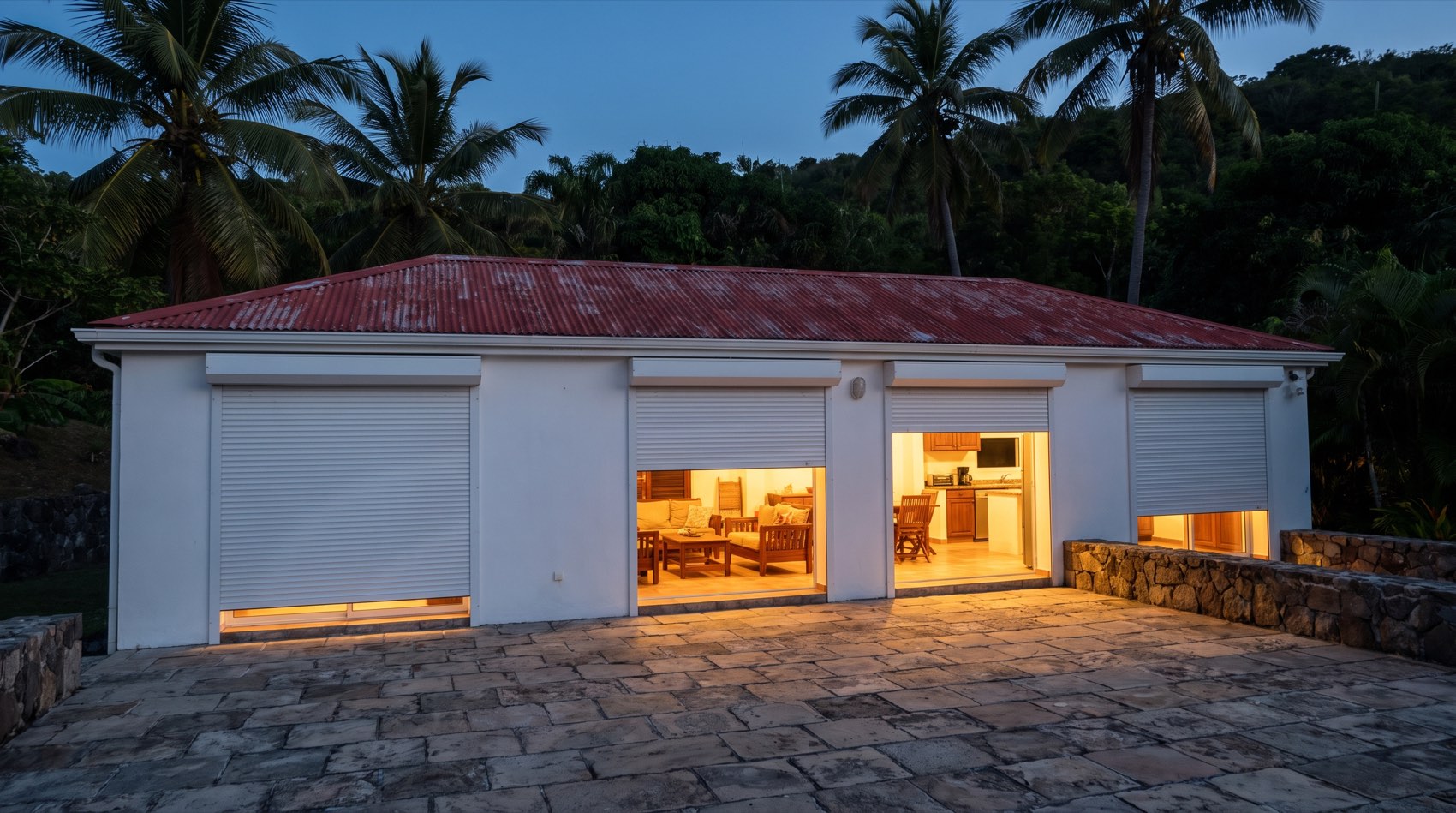
A white Caribbean villa at dusk with white roll shutters lowered to different heights across four wide openings, warm light spilling out beneath them.

Home / Hurricane Shutters

Roll and accordion hurricane shutters

Two systems, both extruded from marine-grade aluminium, both rated to the wind pressures the U.S. Virgin Islands is designed for. Here is how each one works and how to choose between them.

System one

Roll shutters

A curtain of aluminium slats that coils into a box above the opening. Closed, it is a solid wall of metal. Open, it is a slim box under the lintel and nothing else.

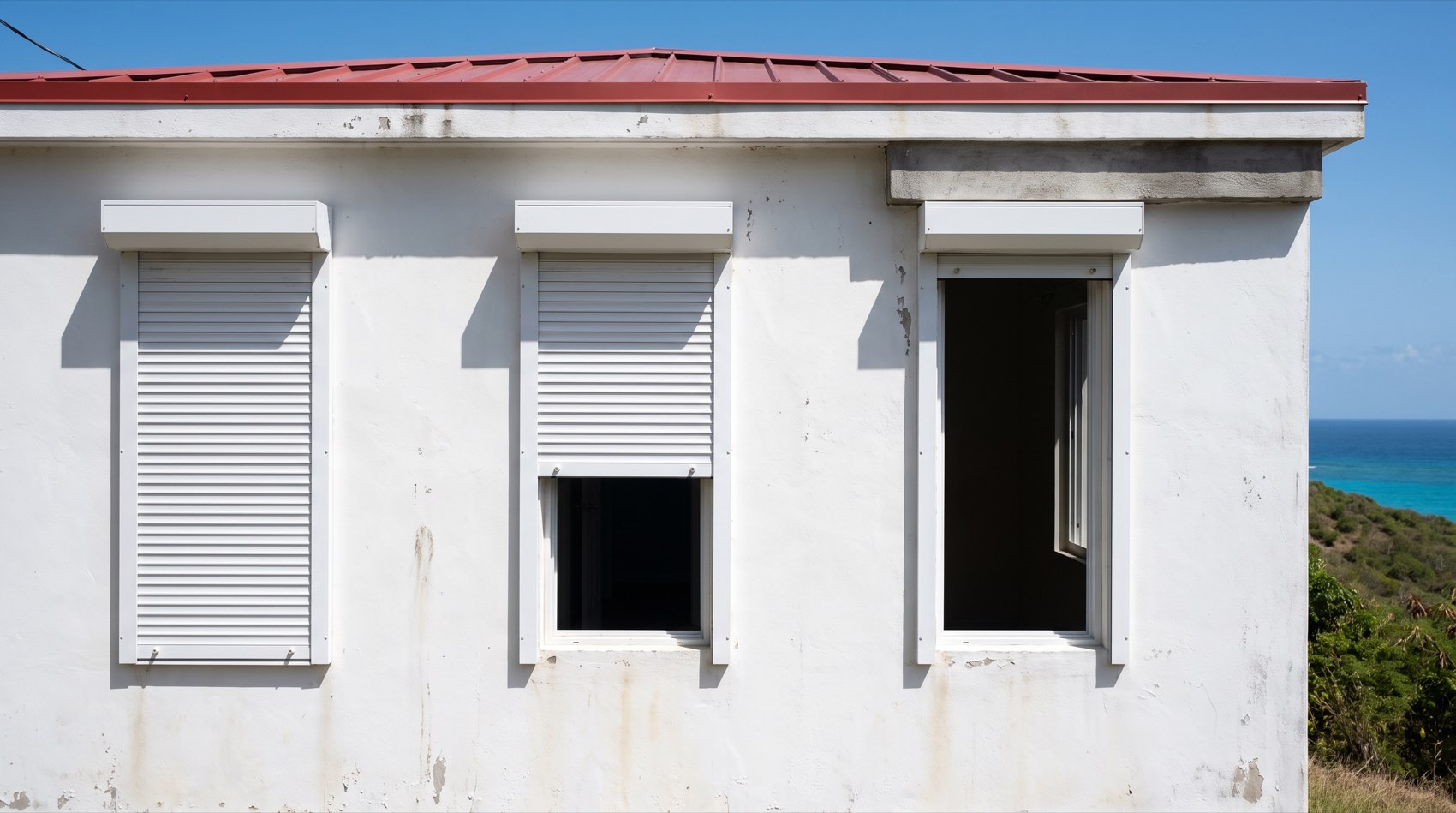
Three windows on a white West Indian house fitted with white roll shutters: one fully closed, one lowered halfway, one fully open showing only the headbox above.
The same three windows, three positions — closed, half down, and fully open with only the headbox showing. That last one is the whole argument for a roll shutter.

How it works

Interlocking aluminium slats run in guide rails screwed into both jambs. The rails carry the wind load into the wall; the curtain spans between them. Above the opening, a headbox holds the roller tube and the coiled curtain when it is up.

Closing it

Manual units use a crank handle that passes through the wall, so you close the house from inside. Motorised units run off a switch or a remote. Every motorised shutter we fit also has a manual override, because power here goes out — if the grid drops with the shutters up, you can still wind them down by hand.

What it does the rest of the year

Halfway down it takes the afternoon sun off a west-facing wall and cuts what the air conditioning has to fight. All the way down it blacks a bedroom out and locks the opening while the house sits empty.

Want these priced on your house?

System two

Accordion shutters

Hinged aluminium blades that fold flat against the jamb and pull across by hand. The most protection per dollar, and the only sensible answer to a very wide opening.

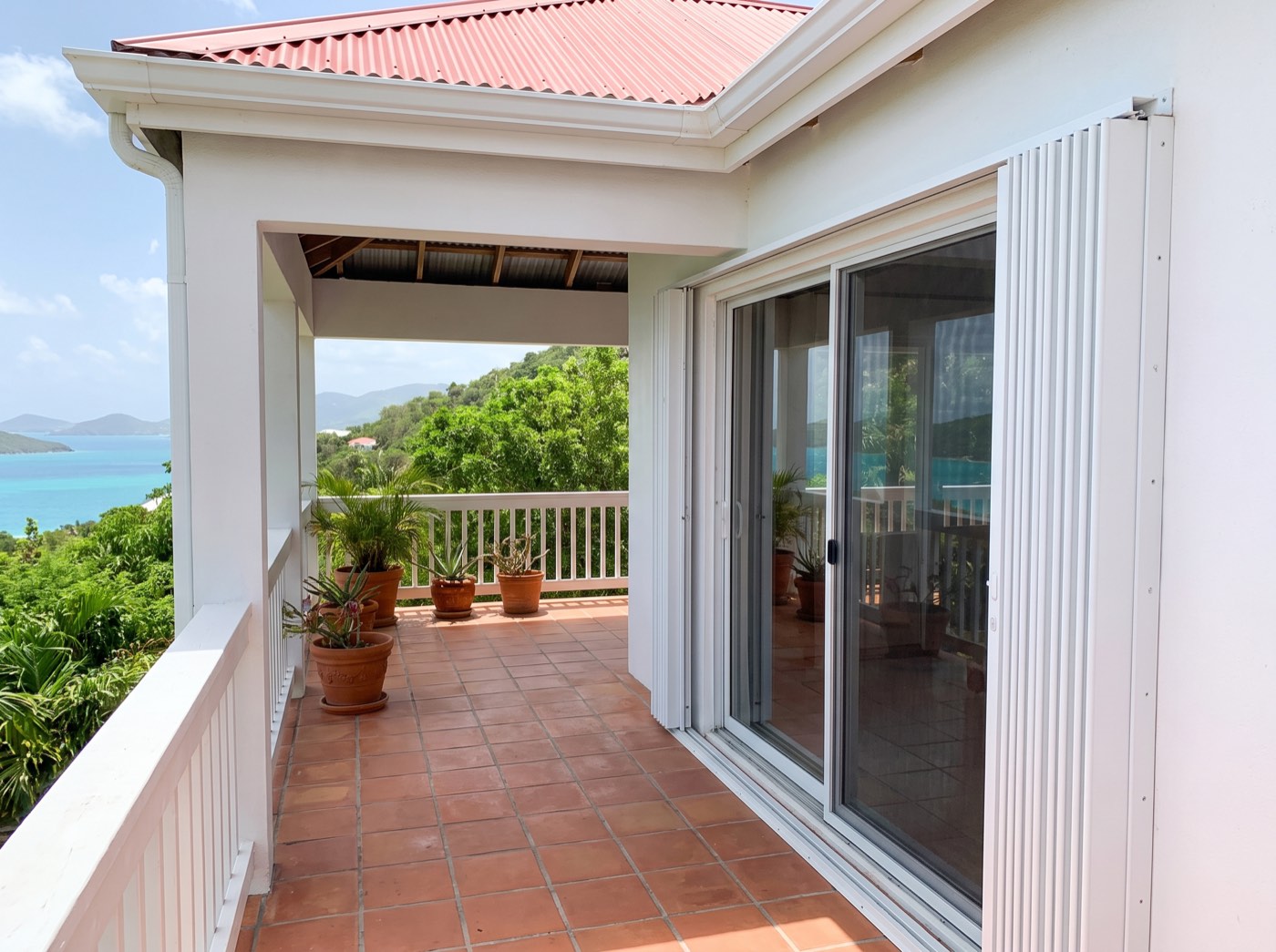
White accordion shutters folded back beside a wide sliding glass door on a Virgin Islands veranda overlooking a turquoise bay.
Stacked open at the jamb on a veranda slider. This is what an accordion looks like for the eleven months it is not working.

How it works

Blades are hinged in pairs so the assembly folds like a concertina. The top track carries the weight; the bottom track guides it. On a long span, centre posts break it into shorter, stiffer sections. It is a simpler machine than a roll shutter, and simpler things fail less.

Closing it

Unlatch the stack, walk it across, mate the two halves at the centre post, turn a key. No motor, no power. It locks from inside or outside, which is what makes it the practical choice for a shop closing at night or a house closing for the season.

What you trade

It is visible when it is open — the stack sits at the jamb all year, and colour matching will not make it disappear the way a roll shutter does. On a front elevation that matters. On a rental, a side wall or a shopfront, it does not.
Not sure which belongs where?

Choosing between them

Both meet the same wind pressures. The decision is almost never about protection — it is about how the shutter behaves on the other three hundred and sixty days.

 Roll shuttersAccordion shutters
Storm protectionRated to territory design pressuresRated to the same pressures
Closing the houseFastest — from inside, crank or switchQuick, but you walk to each opening
Visible when openA slim box above the openingA folded stack at the jamb
Very wide spansExpensive past about 12 feetHandles almost any width
Needs powerOnly if motorised, always with overrideNever
Heat and blackoutExcellentPartial shade and privacy
CostHigherLower
Best onVillas, bedrooms, front elevationsVerandas, sliders, storefronts, rentals

Most houses end up with both

Questions we get asked

How much do hurricane shutters cost?

It is priced per square foot of opening, and accordion runs meaningfully less than roll for the same window. We do not publish a number, because a quote built without measuring is a number somebody has to walk back later. The measure is free, and it gives you a written price per opening for both systems.

Roll or accordion?

Roll if the opening is one you look at every day and you want the shutter invisible. Accordion if the opening is very wide, or the budget has to cover the whole house. Most properties end up mixed — roll on the front and the bedrooms, accordion on the veranda. That is usually the right answer, not a compromise.

Will shutters lower my insurance?

Approved opening protection is something carriers rate on, and many reduce a windstorm premium for a fully protected property. How much depends entirely on your carrier. We give you the documentation they ask for; we will not promise you a discount we do not control.

How long does it take?

Out of season, a few weeks from signed quote to finished install. Once the season is running, four to eight weeks — everybody on all three islands decides at once. The install itself is one to three days for a typical house.

How much maintenance do they need?

Very little, but not none. Rinse the tracks with fresh water every few months to clear salt, use a dry silicone lubricant twice a year, and cycle every shutter fully once before June. That last one is how you find the unit that has seized while there is still time to fix it.

Still have a question?

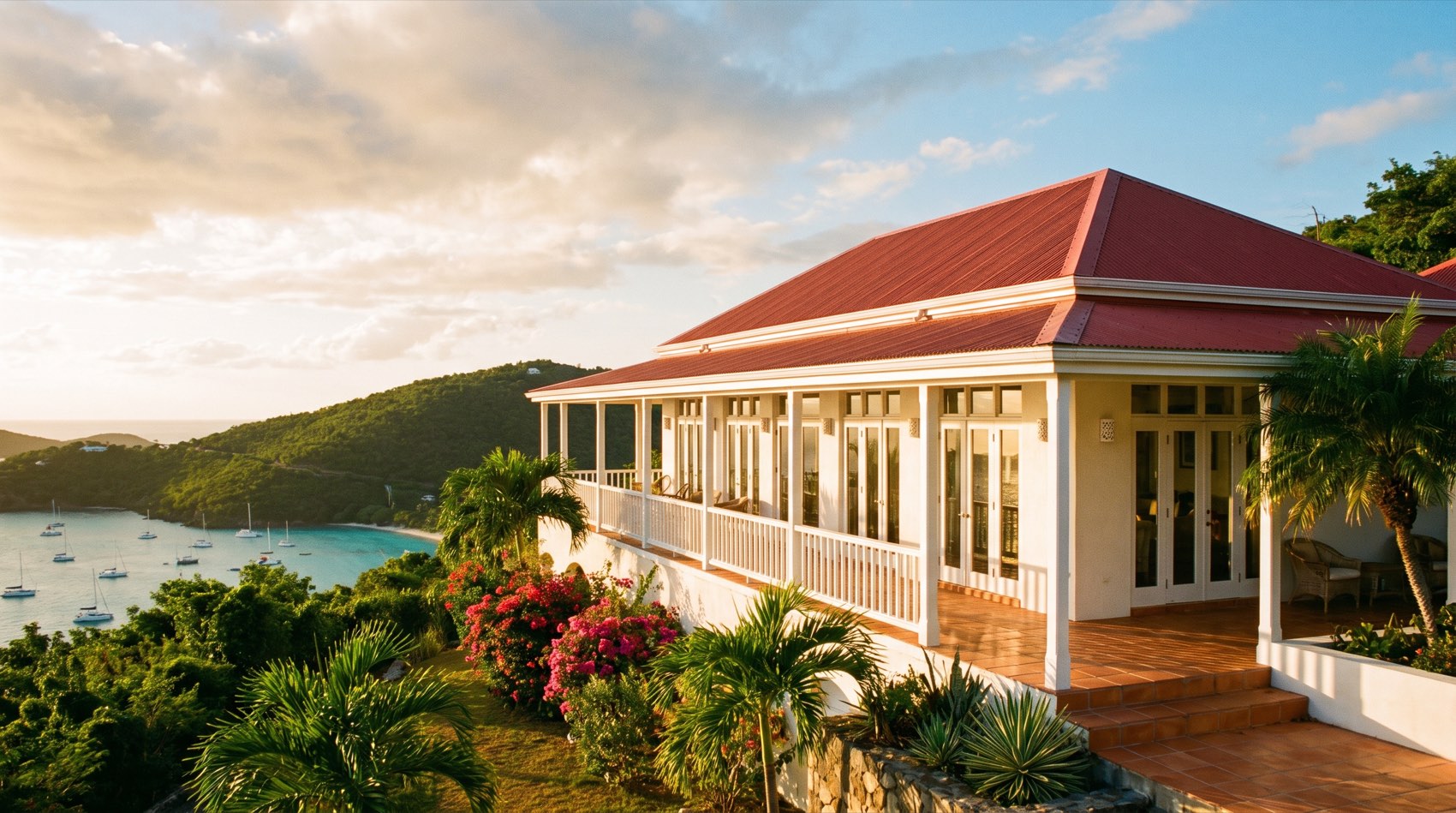
A Virgin Islands villa at golden hour, its long veranda lined with tall windows and sliding doors above a turquoise bay.

Let’s measure your openings

We come out, measure every window and door, and give you a written price for each system.

WhatsApp us